Truck-Mount or Portable? Cleaning a Fifth-Floor Flat in a Maida Vale Mansion Block
Portable.
That was my answer to a woman who rang from a flat on Elgin Avenue with a question she’d clearly rehearsed. She had read that truck-mounted machines clean better, she wanted a truck-mount, and she wanted to know if we had one. We do. It’s a good machine, and it cost more than my first house deposit. It stayed at the depot, and her carpets came out clean.
The rest of this is why.
What Does a Truck-Mounted Carpet Cleaner Do Better?
On paper, almost everything.
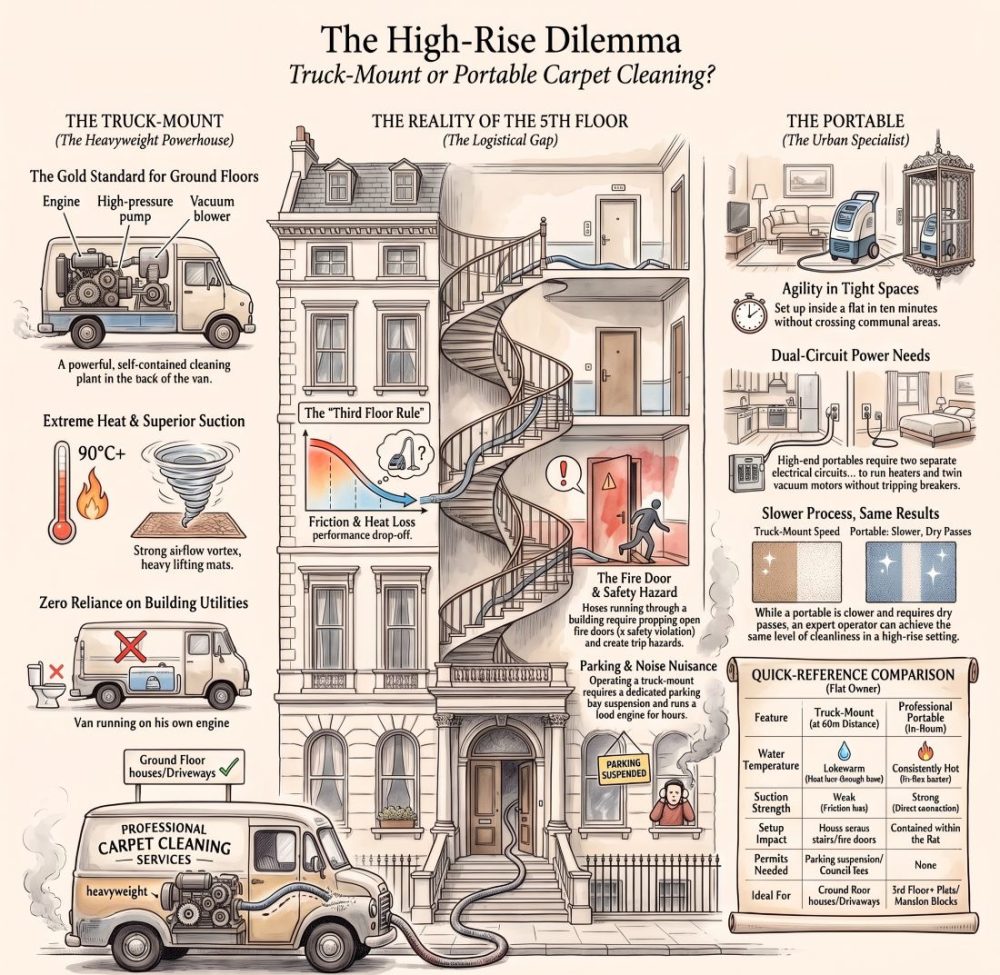
A truck-mount is a cleaning plant bolted into the back of a van, with its own engine driving the vacuum blower and pump, and heat taken off that engine to warm the water. It heats water hotter and more consistently than anything that plugs into a wall socket, and its blower moves far more air than the vacuum motors in a portable machine. The waste goes into a tank in the van, so nothing gets tipped down a customer’s toilet, and it draws no electricity from the property.
On a large, heavily soiled ground floor with somewhere to park close by, a truck-mount is the best tool in the trade, and I wouldn’t argue otherwise. A four-bedroom house in Southgate with the van on the drive and twenty metres of hose to the furthest bedroom is what these machines were built for.
Why Heat and Airflow Matter to Drying
Hotter water loosens oily soil faster and needs less detergent to do it. Stronger airflow pulls more of that water back out of the carpet on each pass. The combination means a truck-mounted clean usually leaves the pile drier than a portable does, and a drier carpet is ready to walk on sooner and less likely to wick soil back to the surface. That advantage is real. It depends entirely on the machine being close enough to the carpet to deliver it.
What Happens to a Truck-Mount’s Performance Over a Long Hose Run?
It drops away, and faster than most customers expect.
Every metre of vacuum hose adds friction to the airflow. Every metre of solution hose sheds heat into whatever it’s lying on – a cold marble stair, a draughty communal corridor, the pavement in January. The machine at the kerb might be producing water well above ninety degrees and a vacuum strong enough to lift a doormat, but what arrives at the wand after a long run is lukewarm water and suction that feels like a decent domestic vacuum on a bad day.
Manufacturers publish hose length limits, and most operators work well inside them for good reason. Past a certain point you’re dragging hose for the sake of saying the truck-mount did the job.
Now take the Elgin Avenue flat. An Edwardian mansion block, fifth floor, with the flat’s front door at the far end of a long corridor and the living room at the far end of the flat. From the nearest parking to the living room is roughly sixty metres of hose route, and that route runs up a stone staircase that turns back on itself ten times. You can’t run hose up a lift shaft, and the lift in that block is an original cage lift about the size of a phone box.
So the hose goes up the stairs. It lies across five half-landings and every step in between. Residents coming down with shopping step over it, and the communal stair runner needs protecting underneath it. The porter has to agree to all of this, and on a Saturday morning the porter isn’t there.
I learned the lesson years ago in a block off Kilburn High Road, four floors up, when I was younger and more stubborn about the van. We ran the hose up the stairwell, propped nothing, and lost most of an hour to a dog and a pushchair. The wand at the far end felt weak, the water was barely warm, and the carpet took until the next morning to dry – longer than a portable would have left it. As a rule, the machine at the kerb loses the argument somewhere around the third floor. I cleaned the last bedroom with the hose kinked round a door frame and the customer holding it straight for me, which is not something anybody should be paying for.
There’s a smaller cost that customers never see. Hose dragged over worn stone steps scuffs, and a hose dragged over a painted stair edge in a freshly decorated common part marks it. The managing agent sends the bill to the leaseholder who booked us.
The Fire Door Problem
Mansion blocks and converted buildings have fire doors on staircases and between corridors, and they’re there to hold smoke back long enough for people to get out. A hose run through a block means those doors have to stay open, which means propping them, which no managing agent should permit and most won’t. A door closed on a vacuum hose crushes it and kills the suction anyway.
This alone rules a truck-mount out in most of the mansion blocks I work in. The hose has no safe route to the flat.
Can You Park a Van Outside a Maida Vale Mansion Block?
Sometimes, with notice and a cost.
Maida Vale sits under Westminster’s controlled parking, and the streets of mansion blocks around Elgin Avenue and Randolph Avenue are lined with residents’ bays. Trade vans can use pay-by-phone bays where there are any, for limited periods, but a truck-mount has to park within hose reach of the entrance and stay there for the length of the job. That usually means applying to the council for a bay suspension, which takes days of notice and adds a fee to the job that the customer ends up paying.
The main road itself carries heavy traffic and waiting restrictions, and stopping there for three hours with hoses crossing the pavement isn’t an option. Even with a suspension granted, there’s no guarantee the bay will be empty when you arrive. A car parked there before the signs went up tends to stay put for the morning.
Running an Engine Under Somebody’s Window
A truck-mount’s engine runs for the whole clean. In a quiet residential street lined with bedroom windows three storeys up, that’s a long morning of engine noise and exhaust for everybody in the block, most of whom didn’t book a carpet clean. Councils in central London take engine idling seriously, and while a cleaning plant isn’t the same as a van idling at the lights, a resident who complains won’t be interested in the distinction.
How Good Is a Portable Machine in a Mansion Block Flat?
Good enough, if it’s a proper one and the person using it knows what they’re doing.
A professional portable extractor is a very different thing from a supermarket rental. The machines we take into flats have twin vacuum motors and an in-line heater, and the pump delivers real pressure at the wand. They fit in the cage lift. They go up and down in ten minutes, and nothing crosses a single communal space.
Power is the first thing to check. As a rule, a portable with heater and twin motors needs two separate circuits so it doesn’t trip the flat’s electrics, and some mansion block flats still have old wiring where two sockets in the same room share a circuit. We ask to see the consumer unit before we plug in, and we’ll run one lead from the kitchen and one from a bedroom.
Water comes from the kitchen tap, heated in the machine. Waste goes into the recovery tank and is emptied down the toilet, with the customer’s agreement, several times over the job.
The Elgin Avenue flat had a wool-rich Wilton in the living room and a cheaper twist in two bedrooms. We pre-sprayed and agitated with a brush, gave the heater time to reach temperature, and made slower, overlapping passes than a truck-mount would need, with extra dry passes at the end to take up more water. Then two air movers and the sash windows open a few inches. The living room was dry enough to walk on by mid-afternoon.
What a Portable Can’t Match
A portable is slower. On a very greasy, very neglected carpet it can’t match the heat of a truck-mount, and it leaves the carpet slightly wetter, so drying equipment isn’t optional. On a large flat with heavily soiled carpets, a portable job can take most of a day where a truck-mount would take half. As a rule I tell customers to expect a longer visit and plan for it.
Is Running Hoses Up the Outside of the Building Ever Acceptable?
Some firms get round the stairwell problem by lowering hoses out of a window to the van below. I think that’s unacceptable in a mansion block, and I’d say so to the firm doing it.
Five storeys of hose hanging down a brick facade has a lot of weight in it, especially the vacuum line full of dirty water, and it’s tied off to a sash window frame that may be a hundred years old. It passes the windows of four other flats. It crosses the pavement at the bottom where people walk with pushchairs. If a fitting fails, a stream of hot, dirty water comes down the front of the building. Most managing agents would never agree to it, and the ones who don’t find out until afterwards tend to take it up with the leaseholder.
The Question to Ask the Managing Agent First
Before booking any carpet cleaning in a block, ask the managing agent or porter what the building’s rules are for contractors: access times, use of the lift, where the van can stop, and whether any machinery is permitted in the common parts. In a Barbican tower or a new-build development with a concierge, you’ll often get a written contractor pack. In an older block in Maida Vale, you’ll more likely get a phone number for a porter who works weekdays until four.
His name is written on a card in the entrance lobby, in pencil, beside the lift button.