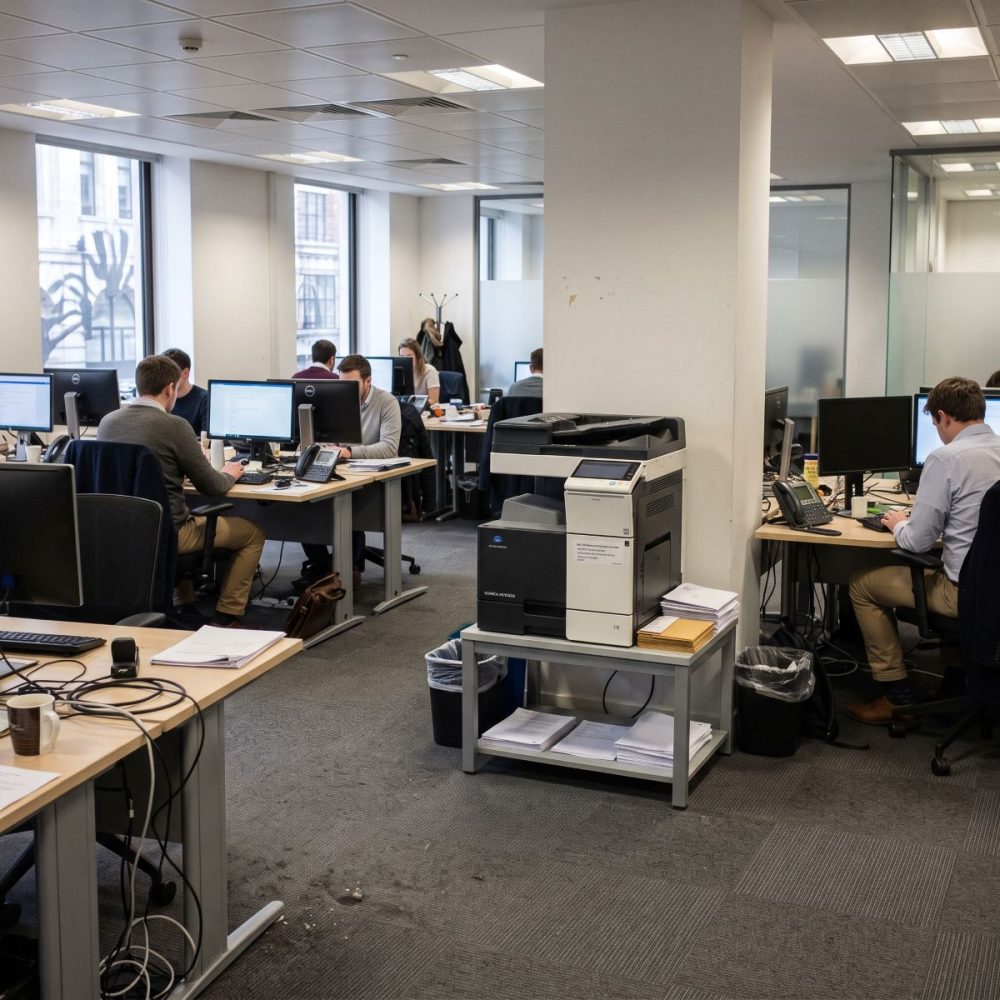
Printer Toner Spilt on the Office Carpet: Why Hot Water Is the One Thing You Mustn’t Use
The call came in at twenty to eight on a Tuesday. A building manager on Clerkenwell Road, EC1M, whose night cleaner had knocked a full waste toner bottle off the back of the multifunction printer by the second-floor lifts.
“It’s fine,” he said. “She’s already had the wet vac on it.”
She had filled the machine from the hot tap in the cleaners’ cupboard, and by the time we arrived there was a grey smear three metres long running from the printer towards the kitchen, with a darker core where she had gone over it twice. We saved about a third of what she’d touched. The rest went into a skip on Farringdon Road.
What Happens to Toner When It Meets Hot Water?
Toner is plastic. People picture it as ink in powder form, and that picture sends them straight to the kitchen tap.
Each particle is a speck of resin – usually a styrene-acrylic or polyester polymer – carrying pigment and a little wax, somewhere around five to ten microns across. The printer’s fuser presses it onto paper at high temperature, but the resin starts to soften far lower than that, in the region of fifty to sixty-odd degrees Celsius depending on the formulation. A portable extraction machine with an inline heater delivers water close to that range. A truck-mount will put it through the carpet hotter still.
So a hot water extraction clean on a toner spill is, in effect, a very slow and very wet fuser. The resin softens, wraps itself around the nylon fibres and cools there. What was loose powder an hour ago is now a thin plastic coating on thousands of tufts, and no rinse brings it back out.
Detergent makes it worse. Surfactants exist to break surface tension and carry soil downwards, and they do that job faithfully with toner, pulling particles past the tips and into the base of the pile, then into the tile backing.
Why Cold Water Is Barely Better as a First Move
Cold water won’t melt anything, and that’s the only thing going for it. Toner repels water until there’s enough agitation to force the two together, at which point you get a grey paste that behaves like fine silt – it wicks and spreads sideways, then dries into the pile as a stain instead of sitting on top as dust.
Water comes last, if at all.
What Should You Do in the First Hour After a Toner Spill?
Keep people off it. That sounds obvious until you watch a whole sales team step round a cone to get to the kettle and carry grey footprints down a corridor of charcoal-and-cream tiles.
Then hold back the cleaning trolley. The night team’s upright vacuum is the next thing most offices reach for, and for my money it does more damage than the spill itself. An ordinary bag vacuum isn’t built to hold particles that fine. They go through the bag and the filter and out of the exhaust, and the grey film that settles on desks and along the top edges of partition screens over the following hour is the same toner, redistributed across the floor plate. Fine toner dust is combustible in a dense enough cloud, too, and a brushed motor full of it is not where you want that cloud forming.
Check the floor grilles. A lot of Grade A space in London supplies air through a raised access floor, and a spill beside a floor diffuser can be in the plenum within minutes. Ask whoever runs the building to shut that zone down.
Open a window if the building has any that open. Whoever does the lifting should wear disposable gloves and a dust mask – toner is classed as a nuisance dust rather than anything exotic, but a morning of breathing it in off your knees at floor level is a morning nobody enjoys, and the grey gets into the creases of your knuckles for days.
After that, dry removal. Lift the heaped powder with a piece of stiff card, sliding it under the heap at a low angle and tipping it into a bag you can seal. Don’t brush. Toner is made to cling to anything carrying a charge – that’s how the printer drum picks it up – and brushing builds static, so a dustpan brush turns a neat heap into a wide grey halo. Leave everything the card can’t lift for someone with a toner vacuum, meaning a unit with HEPA-grade filtration and a conductive, earthed hose. Most managed print engineers carry one in the van, and buying one outright costs a few hundred pounds.
The Carpet Tile Advantage Nobody Uses
Most offices with this problem are standing on carpet tiles, and a tile can be lifted.
This is the step I’d push hardest, because it takes ten minutes and avoids most of what follows. Pull the affected tiles with a tile lifter or a flat screwdriver, keep them level so nothing slides off, and carry them outside. On a loading bay you can vacuum the backs properly and look at the face in daylight without dragging the surrounding floor into it. Swap in tiles from under a filing cabinet while they’re out. Nobody sees the join under a pedestal.
A council office in Croydon, CR0, did exactly this with four tiles by a print bay and rang us afterwards to ask whether they still needed a visit. They didn’t, and I told them so.
How Do Professionals Remove Toner From Carpet Fibres?
When we do attend, most of the job is the toner vacuum and patience.
Slow passes in several directions, with the pile lightly groomed between them so particles lodged at the base get lifted to where suction can reach. It is dull work. On a spill the size of a dinner tray it can take forty minutes before we open a bottle of anything.
Then a dry solvent spotter, applied to a white cloth and never poured onto the carpet, blotted and tamped with a soft brush. Volatile dry solvents loosen the waxy fraction of toner without introducing heat or water. We work from the outside of the mark inwards, change cloths constantly and keep rotary machines well away, because friction makes warmth.
Only after that, and only if a grey cast remains, does water go near it: a cold neutral rinse through the wand at room temperature, heater off, as few passes as the job allows.
Turning the Heater Off Is Harder Than It Sounds
A truck-mounted machine heats its water through a heat exchanger that stays hot long after you turn it down, and the solution hose running up from the van holds a warm slug of water for the first stretch of any job. On toner we either let the whole system cool completely or bring a portable with the element disconnected. For my money the portable is the right tool on every toner job, whatever the size of the building. On a sixth floor at Merchant Square, W2, the truck-mount sat in the car park all day and nobody touched it.
Can Toner That Has Already Melted Into the Carpet Be Removed?
Partly, sometimes.
Fused toner responds to repeated solvent work if the coating is thin, and solution-dyed nylon – which most commercial tiles are – tolerates that treatment far better than a wool-rich carpet would. The grey lightens. It rarely disappears. What usually remains is a flat, slightly darker area that shows as a shadow in raking light from a window and vanishes under the standard office downlights. On the Clerkenwell job the shadow became the whole argument. The tenant had eighteen months left on the lease and could live with it. The landlord’s surveyor, at the end of those eighteen months, would not.
Broadloom changes the maths. You can’t lift a section and swap it, and patching cut-pile commercial broadloom needs a matching offcut and a fitter who is good with a seam.
When Replacement Is Cheaper Than a Second Visit
If a first solvent attempt on fused toner hasn’t taken the colour back by at least half, I tell the client to stop paying us. A replacement tile from a current range costs a fraction of a second attendance, and a building that kept its attic stock – the spare boxes the fit-out contractor leaves in the plant room – can have the floor right by lunchtime.
Most buildings threw those boxes out years ago.
Who Should Be Responsible for Toner Spills in an Office?
The print provider, for my money.
Nearly every London office running a fleet of multifunction machines is on a managed print contract, and the engineer who changes the waste toner bottle is the person with the right vacuum and, often, a spill clause in the service agreement. Facilities managers ring the carpet cleaner out of habit. A call to the print helpdesk will frequently get an engineer out to clear the loose powder, and then the question of whether a contractor like us is needed at all becomes a much smaller one.
Carpet under a print station is a specification mistake, and interior designers keep making it. A multifunction printer sheds heat and paper dust all day, and every so often it sheds toner. It belongs on a hard floor bay or at the very least on a rigid mat of the kind that goes under an office chair. A forty-pound mat would have spared the tenant on Clerkenwell Road a morning’s disruption and a skip. Designers say a mat breaks up the look of the floor plate. It does. So does a grey smear three metres long.
A Laminated Card by the Machine
The cheapest fix is telling the night cleaners before it happens. Most spills are found out of hours by someone who has never been briefed about toner and has a wet vac and a hot tap within reach. A card on the printer saying no water, no ordinary vacuum, no brushing, then cone it off and ring the print helpdesk, covers most of it.
The one at Merchant Square is cable-tied to the side of the paper tray, just above the stapler.